Designing APIs
HTTP semantics, idempotency, pagination, versioning and error contracts — the parts of API design that come up when someone asks you to defend a decision.
Table of contents
Most API questions are not really about REST. They are about what happens when the network fails halfway through, when the client retries, when the data set grows past what a single response can carry, and when you need to change the shape of something that other teams already depend on.
This note is organised around those failure modes rather than around a style guide.
Safe, idempotent, neither
Three properties, and almost every retry decision follows from them.
- Safe — the request does not change server state.
GET,HEAD,OPTIONS. - Idempotent — sending it N times leaves the same state as sending it once.
GET,HEAD,PUT,DELETE,OPTIONS. - Neither —
POSTandPATCH.
Safe implies idempotent. The reverse is not true: DELETE /orders/42 changes state, but
running it five times leaves the same state as running it once.
This matters because anything not idempotent cannot be safely retried by a client, a proxy, or a load balancer. A timeout does not tell the client whether the request was applied. If the operation is idempotent, the client can just send it again. If it is not, retrying might charge a card twice.
PUT is idempotent because it carries the complete desired state. PATCH usually is not,
because it carries a delta — PATCH /accounts/1 {"balance_delta": -10} applied twice
removes twenty. A PATCH that carries absolute values ({"status": "cancelled"}) is
idempotent in practice, but the method does not promise it, so intermediaries will not
assume it.
A DELETE that returns 204 the first time and 404 the second is still idempotent.
Idempotency is about resulting state, not about identical responses.
Status codes that carry information
You do not need all of them. You need the ones whose meaning is load-bearing.
| Code | Use it when |
|---|---|
200 | Success with a body |
201 | A resource was created — include a Location header |
202 | Accepted, not finished — see the async section below |
204 | Success, deliberately no body |
400 | The request is malformed — it will never succeed as written |
401 | Not authenticated — who are you? |
403 | Authenticated, not allowed — I know who you are, and no |
404 | Not found, or hidden from this caller on purpose |
409 | Conflict with current state — duplicate key, version mismatch |
412 | A precondition (If-Match) failed |
422 | Syntactically valid, semantically wrong — the shape parses, the values do not |
429 | Rate limited — include Retry-After |
5xx | You broke it, not the caller |
The 400 versus 422 line is the one people argue about. A defensible rule: 400 when
you could not parse it, 422 when you parsed it fine and the values violate a business
rule. What matters in an interview is that you have a rule and apply it consistently.
The 403 versus 404 line is a security decision. Returning 403 on a resource the
caller cannot see confirms that it exists. For tenant-scoped resources, 404 leaks less.
Practice
A client sends POST /orders, times out, and retries. You now have two orders. Whose fault is it?
Nobody's, and that is the point. POST is not idempotent, so the client was within its
rights to retry, and the server was within its rights to create a second order. The
protocol does not solve this — you have to, with an idempotency key.
Why is PUT /users/7 idempotent but POST /users not?
PUT names the resource, so the second call overwrites the same address. POST asks the
server to create something and assign an identity, so the second call creates a second
thing.
Idempotency keys
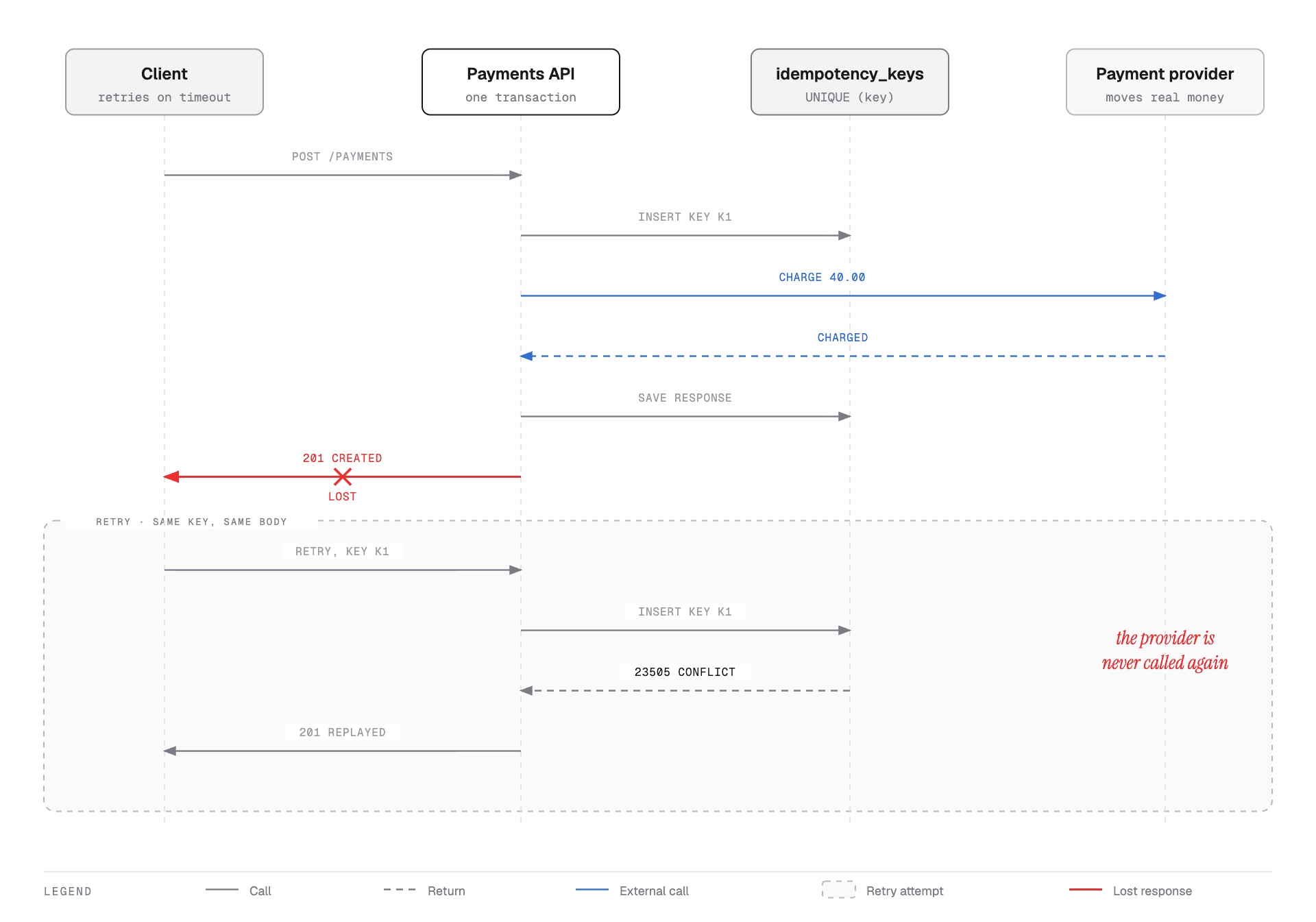
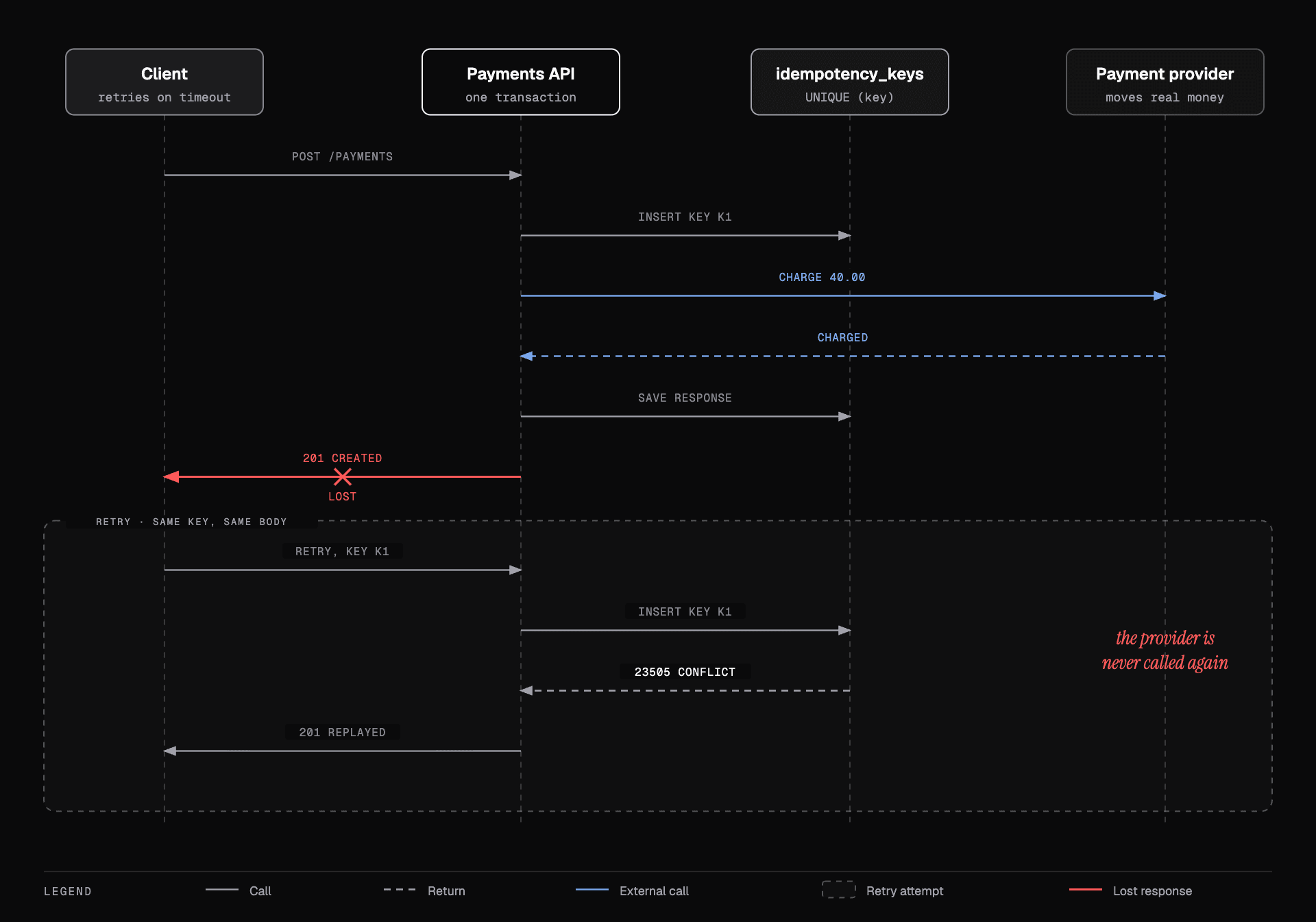
A client-generated key, unique per logical operation, sent on requests that are not naturally idempotent.
POST /payments HTTP/1.1
Idempotency-Key: 7c9e6679-7425-40de-944b-e07fc1f90ae7
Content-Type: application/json

{"amount_cents": 4000, "currency": "USD", "order_id": 812}
The server side, in one transaction:
CREATE TABLE idempotency_keys (
  key             text PRIMARY KEY,
  request_hash    text NOT NULL,
  response_status int,
  response_body   jsonb,
  created_at      timestamptz NOT NULL DEFAULT now()
);INSERTthe key. If it violates the primary key, this is a replay — read the stored response and return it.- If the insert succeeded, do the work.
- Store the status and body against the key before committing.
Three details that separate a real answer from a memorised one:
Store the request hash. If the same key arrives with a different body, that is a
client bug, not a retry. Return 422 rather than silently replaying an unrelated
response.
Handle the in-flight case. The first request may still be running when the retry
arrives. The row exists but has no response yet. Return 409 and let the client retry
later — this is the honest answer, and better than blocking a connection.
Expire the keys. They are not permanent records. A 24-hour or 7-day retention window with a cleanup job is normal. Say this out loud; unbounded growth is a real operational cost.
How to say it: "The client sends a key, the server makes that key unique in the database, and the uniqueness constraint — not an application-level check — is what guarantees the operation runs once."
What the key is scoped to
The key identifies one logical attempt. Not one click, and not one session. That distinction is where most implementations leak.
A key generated inside the click handler produces a new key on every click, which is the same as having no key at all. It has to be created once, when the operation becomes possible, and held for as long as that operation can still be retried.
function CheckoutForm({ cart }) {
  const idempotencyKey = useRef(crypto.randomUUID()).current;

  async function pay() {
    await fetch("/payments", {
      method: "POST",
      headers: { "Idempotency-Key": idempotencyKey },
      body: JSON.stringify({ amount_cents: cart.total, order_id: cart.orderId }),
    });
  }
}
Held that way, a double click sends two requests carrying the same key, and the server
resolves them with the three steps above: the second one either gets 409 because the
first is still in flight, or replays the stored response. Disabling the button is still
worth doing, but it is a UX improvement, not the correctness boundary — two tabs, a flaky
connection and a backgrounded mobile browser all get past it.
The gap is the reload. A key held in component state dies with the component, so a refresh
produces a new key and the server sees a genuinely new payment. Moving it into
sessionStorage keyed by the order closes the refresh case, and still loses on a different
device or cleared storage.
The structural fix is to stop relying on client-side randomness and anchor the operation to a resource the server created:
POST /payment-intentswith{"order_id": 812}— deduplicated by a unique constraint onorder_id, returnspi_abc.POST /payment-intents/pi_abc/confirm— the URL now names the resource, so the operation is idempotent by construction and needs no header at all.
Client-generated keys protect against network retries. Server-issued identifiers protect against client amnesia — a refresh, a crash, a different device. Payment providers ship both layers, and for the same reason.
An idempotency key answers "is this the same request, retried?" It never answers "did the
user mean to do this twice?" A second, deliberate purchase tomorrow is a new intent and
should go through. Guarding against that belongs to the order state machine
(status != 'paid'), not to the key.
Practice
Why not just check "does a payment already exist for this order?" instead?
Two concurrent requests both run the check, both see nothing, both insert. A read-then-write check is not atomic. The unique constraint is.
Where should the key be generated?
The client, before the first attempt, and reused across all retries of that attempt. If the server generates it, a retry gets a new key and the whole mechanism does nothing.
Pagination
Why OFFSET degrades
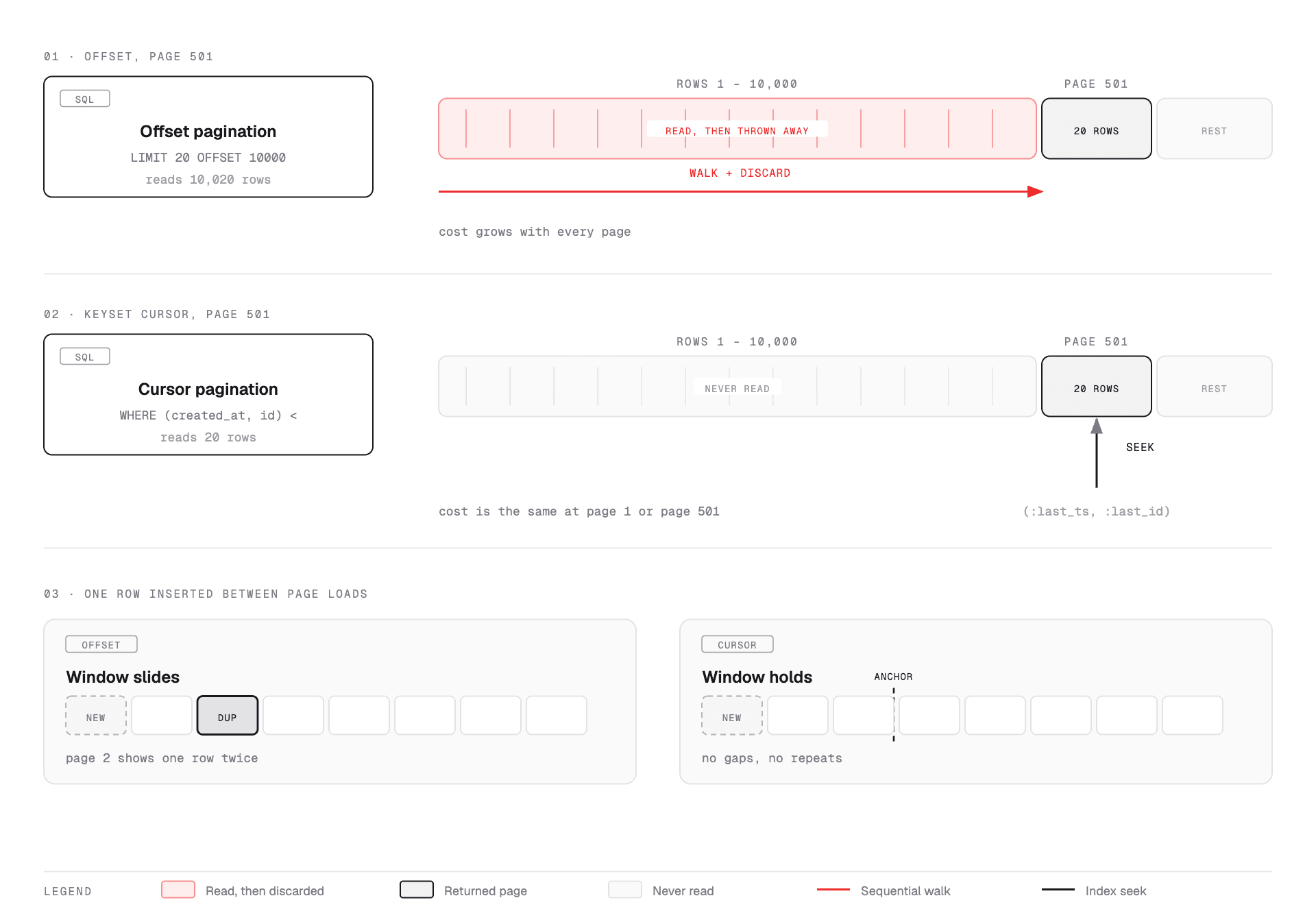
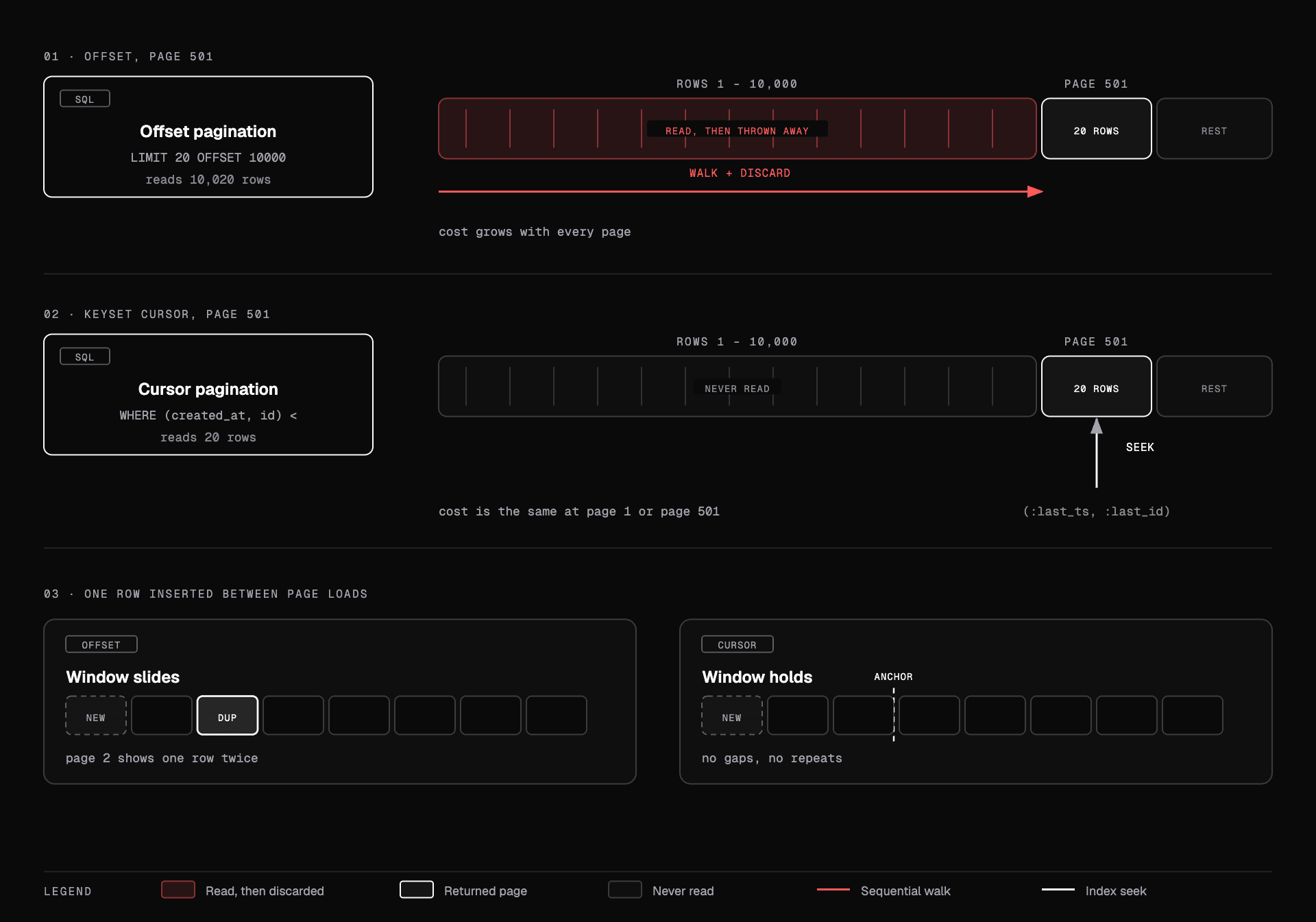
SELECT * FROM orders ORDER BY created_at DESC LIMIT 20 OFFSET 10000;The database cannot jump to row 10,000. It reads 10,020 rows in sort order and discards 10,000 of them. Page 1 is instant, page 500 is a table scan. Cost grows linearly with page number, which means your slowest queries are the ones nobody looks at — until a crawler, an export job, or a bored user walks the whole list.
There is a correctness problem too. If rows are inserted while a user pages, the window shifts underneath them: items get skipped or shown twice.
Keyset (cursor) pagination
Remember where you stopped and ask for what comes after it:
SELECT * FROM orders
WHERE (created_at, id) < (:last_created_at, :last_id)
ORDER BY created_at DESC, id DESC
LIMIT 20;
With an index on (created_at DESC, id DESC), the database seeks straight to the position
and reads 20 rows. Page 500 costs the same as page 1.
Two requirements people forget:
- The sort key must be unique.
created_atalone is not — two rows sharing a timestamp will be skipped or repeated at the page boundary. The tuple(created_at, id)is unique, and the row comparison above compares it as a tuple, not column by column. - The cursor is opaque. Base64-encode it and return it as
next_cursor. Once clients start parsing it, you can never change the sort key.
{
  "data": [],
  "next_cursor": "eyJjcmVhdGVkX2F0IjoiMjAyNi0wMS0wMlQxMDowMDowMFoiLCJpZCI6ODEyfQ=="
}
The trade-off is real: you lose "jump to page 47" and you lose a cheap total count. If the product genuinely needs numbered pages over a small, bounded list, offset is fine. Say the trade-off rather than declaring cursors universally correct.
Practice
Your list endpoint is fast in staging and slow in production. Same query. Why?
Staging has a thousand rows; production has ten million. OFFSET cost scales with the
offset, and staging never reaches a deep page.
A user reports seeing the same order on page 2 and page 3. What happened?
New rows were inserted above the window between requests, shifting everything down by one. Offset pagination over a table with concurrent inserts, sorted by a non-stable key.
Versioning and backward compatibility
What actually breaks a client
Safe (additive): adding an endpoint, adding an optional request field, adding a response field, adding a new value to an enum that clients only display.
Breaking: removing or renaming a field, changing a type ("42" → 42), making an
optional request field required, tightening validation, changing a default, changing
pagination semantics, adding an enum value clients must branch on.
That last pair is the subtle one. Adding status: "partially_refunded" is additive to a
client that prints the status and breaking for a client with a switch statement over three
known values. Whether an enum is extensible is part of your contract, and you should state
it in the docs from day one.
Strategies, in the order most teams should try them
- Don't version. Only make additive changes. This covers more ground than people expect, and it is free.
- Version the representation, not the API —
Accept: application/vnd.acme.v2+json. Purist, and awkward to test from a browser or a curl one-liner. - Version in the path —
/v2/orders. Ugly, obvious, easy to route, easy to debug. Most large public APIs land here for exactly those reasons.
A useful framing: URL versioning is a routing decision and media-type versioning is a content negotiation decision. Both work. Pick one and never mix.
Deprecation
A version is not retired when you announce it. It is retired when traffic reaches zero. That means you need per-version, per-client usage metrics before you can set a date. State the sunset in a header so it shows up in client logs:
Deprecation: Sun, 01 Nov 2026 00:00:00 GMT
Sunset: Sun, 01 Feb 2027 00:00:00 GMT
Link: <https://api.acme.com/docs/v2-migration>; rel="deprecation"
Practice
You need to rename user_name to username. How, without breaking anyone?
Add username alongside user_name and populate both. Accept either on writes, preferring
the new one. Mark the old field deprecated in the docs and in a response header. Watch
usage. Remove it when it reaches zero — which is the same expand/contract shape as a
database migration.
Error contracts
Errors are part of your API surface. Clients branch on them, so they are as much a compatibility commitment as your success payloads.
{
  "type": "https://api.acme.com/errors/insufficient-funds",
  "title": "Insufficient funds",
  "status": 422,
  "detail": "Account 812 has 1200 cents available, 4000 requested.",
  "instance": "/payments/9f2c",
  "code": "insufficient_funds",
  "errors": [
    { "field": "amount_cents", "code": "exceeds_balance" }
  ]
}
That is RFC 9457 (Problem Details) plus a stable machine-readable code. The important
properties:
- A stable code, separate from the human message. Clients branch on the code. The message is for humans and may be rewritten or translated at any time.
- Field-level detail for validation errors, so a form can highlight the right input.
- No leaked internals. Never return a raw SQL error, a stack trace, or a constraint
name from the driver.
duplicate key value violates unique constraint "one_active_price"is a database implementation detail; translate it at the boundary.
A 200 OK with {"success": false} in the body is the most common broken error
contract. It defeats HTTP caching, proxy behaviour, client retry logic, and every
monitoring dashboard that counts non-2xx responses.
Authentication and authorization
Enough to speak confidently, without pretending to be an identity specialist.
Authentication is who you are. Authorization is what you may do. Different
failures: 401 and 403.
Token choices. Opaque tokens are random strings looked up server-side — revocation is instant, but every request costs a lookup. JWTs are self-describing and verified by signature, so no lookup is needed, but they cannot be revoked before expiry without reintroducing a lookup (a denylist), which gives back the property you chose JWTs to avoid. The usual compromise: short-lived access tokens (5–15 minutes) plus a long-lived refresh token that is checked server-side.
Where tokens live in a browser. localStorage is readable by any XSS on the page. An
HttpOnly; Secure; SameSite cookie is not, but it is submitted automatically, which is
what makes CSRF possible — so you need a CSRF token or strict SameSite. There is no
option without a trade-off; know which one you took.
Scopes and permissions. A scope says what a token may do. It does not say what the
user may do to a specific row. orders:read does not mean "read order 812" — you still
have to check tenancy on every query. Saying this unprompted signals you have shipped
multi-tenant software.
Rate limiting
Return 429 with the numbers the client needs to behave:
HTTP/1.1 429 Too Many Requests
Retry-After: 30
RateLimit-Limit: 1000
RateLimit-Remaining: 0
RateLimit-Reset: 30
Token bucket is the usual algorithm: a bucket refills at a steady rate and each request takes a token. It permits short bursts (up to bucket size) while bounding the sustained rate — which matches how real clients behave better than a fixed window does.
Fixed windows have a well-known edge: a client can send the full quota at 11:59:59 and the full quota again at 12:00:00, doubling the intended rate across the boundary. Sliding windows fix it at the cost of more state.
Limit per API key or per tenant, not per IP. Mobile carriers and corporate networks put thousands of users behind one address.
Caching and optimistic concurrency
One header does two jobs that look unrelated: not sending a body the client already has, and not overwriting an edit the client never saw.
GET /orders/812
→ 200 OK
  ETag: "order-812-v7"
  Cache-Control: private, no-cache
Caching — the client sends If-None-Match: "order-812-v7" and you answer 304 Not Modified with no body when it still matches.
Lost update prevention — the client sends If-Match: "order-812-v7" on a write. If the
resource changed since, you answer 412 Precondition Failed instead of silently
overwriting someone else's edit. This is optimistic concurrency control, and it is the HTTP
expression of the same idea as a version column.
Without it, two people editing the same record produce last-write-wins, and the first person's change vanishes with no error anywhere.
Who is allowed to keep a copy
Cache-Control is not one setting. It is a set of instructions addressed to different
audiences, and the audiences have different privacy properties — the browser cache holds
one user's data, a CDN holds one copy for everyone.
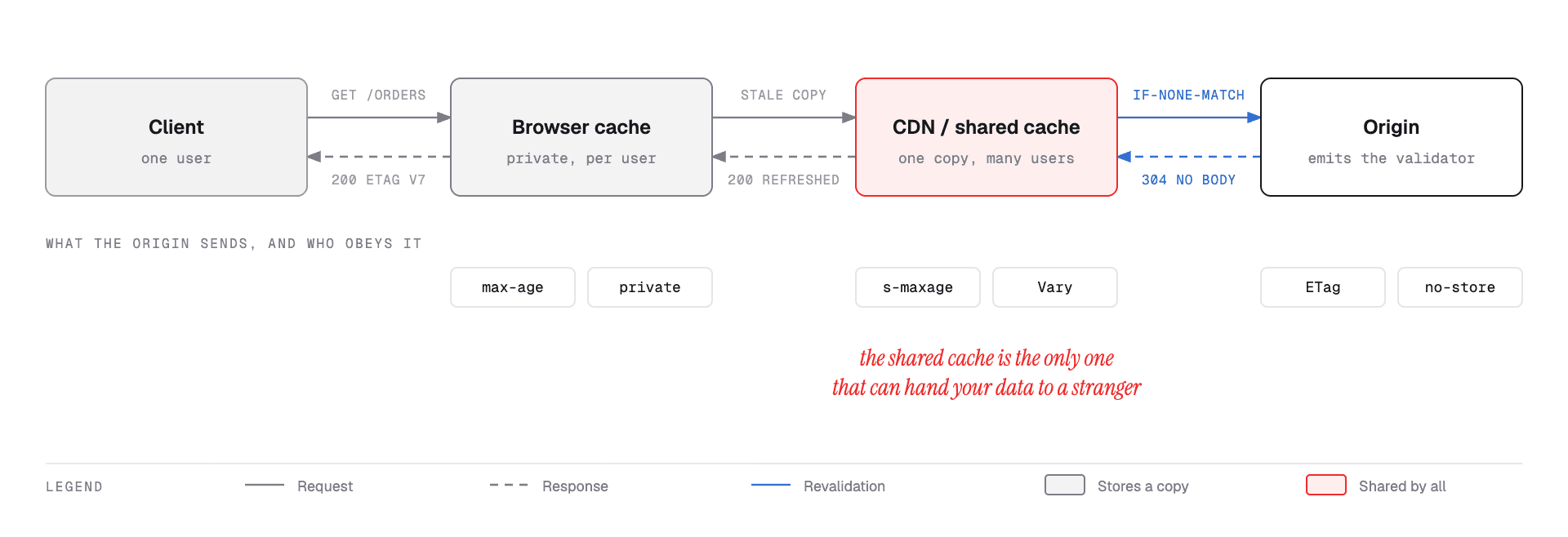
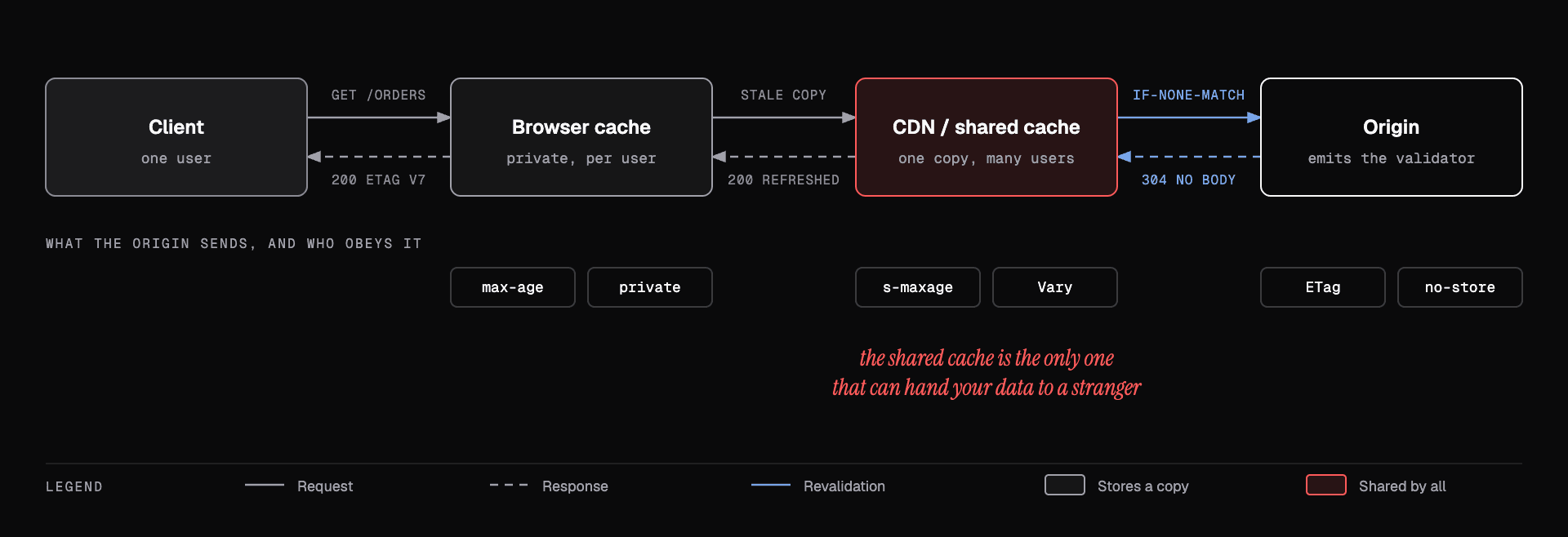
| Directive | Who obeys it | What it means |
|---|---|---|
max-age=60 | Every cache | Fresh for 60s, no revalidation during that window |
s-maxage=60 | Shared caches only | Overrides max-age at the CDN, ignored by the browser |
private | Shared caches | "You may not store this at all" |
no-store | Every cache | Nothing is written anywhere, including disk |
no-cache | Every cache | Store it, but revalidate before every reuse |
must-revalidate | Every cache | Once stale, never serve without checking |
stale-while-revalidate=300 | Every cache | Serve the stale copy for 300s while refreshing behind it |
immutable | Every cache | Never revalidate while fresh — fingerprinted assets only |
no-cache and no-store sound like synonyms and do opposite things. no-cache still
stores the response and only forbids using it without asking. no-store forbids writing it
down at all. If you mean "never persist this", no-store is the one.
Example 1 — the one word that serves one user's data to another
The leak is not exotic. It is a per-user response with a public caching directive, sitting behind a CDN.
export async function GET(req: Request) {
  const user = await authenticate(req);
  const inbox = await getInbox(user.id);

  return Response.json(inbox, {
    headers: { "Cache-Control": "public, max-age=60" },
  });
}
The CDN's cache key is the URL — /inbox — and the URL contains no user. The first
authenticated request populates the entry; for the next 60 seconds every other caller of
/inbox is served that person's mail, authentication never reaching your handler at all.
Two different mechanisms fix it, and they fix different things:
return Response.json(inbox, {
  headers: {
    "Cache-Control": "private, no-store",
    Vary: "Authorization",
  },
});
private (or no-store) tells shared caches to stay out. Vary: Authorization makes the
credential part of the cache key, so a stored entry can only ever be served back to the
same token.
Vary is blunt. One entry per token means a hit rate near zero, which is the correct
outcome for per-user data but a waste for anything else — so use private to express
"this belongs to one person" and keep Vary for genuine negotiation: Accept-Encoding,
Accept-Language, Accept.
Any response whose body depends on who asked must carry private or no-store. A
response that is public but negotiated must list every negotiated header in Vary. A
response that is public and identical for everyone is the only one that gets public, s-maxage=….
Conditional GET, and what it actually saves
export async function GET(req: Request, { params }: { params: { id: string } }) {
  const order = await db.order.findUnique({
    where: { id: params.id },
    select: { id: true, version: true, status: true, totalCents: true },
  });
  if (!order) return new Response(null, { status: 404 });

  const etag = `"order-${order.id}-v${order.version}"`;
  const headers = { ETag: etag, "Cache-Control": "private, no-cache" };

  if (req.headers.get("if-none-match") === etag) {
    return new Response(null, { status: 304, headers });
  }

  return Response.json(order, { headers });
}
A 304 always saves bandwidth. It saves work only when the validator is cheaper than
the response it replaces. Hashing the serialized body means running every query, building
the whole payload, and then throwing it away — the client's bill goes down, yours does not.
Deriving the tag from a version column means one narrow read decides the outcome.
Example 2 — choosing what the ETag is derived from
A monotonic version column is the best default. It changes on every write, it is
cheap to select, and it doubles as the token for If-Match on the write path.
updated_at works until two writes land inside the same timestamp tick, and it drags
in clock questions the moment more than one machine writes. If you use it, store it at
microsecond precision and never derive it from application time.
A hash of the response body is always correct and always expensive. It is the right choice for a computed representation with no version of its own — a rendered PDF, an aggregated report — and the wrong choice for a row you already version.
A collection is the hard case. MAX(updated_at) alone is wrong: delete one row and
insert another within the same tick and the tag is unchanged while the page is not. Pair it
with a count, or version the collection itself:
SELECT count(*) AS n, coalesce(max(updated_at), 'epoch') AS m
FROM orders WHERE customer_id = $1;
-- ETag: "orders-c412-n42-m1719"
That still misses an update-in-place that does not touch updated_at, which is the real
argument for a trigger or a version counter owned by the table rather than assembled at
read time.
If-Match: the same header on the write path
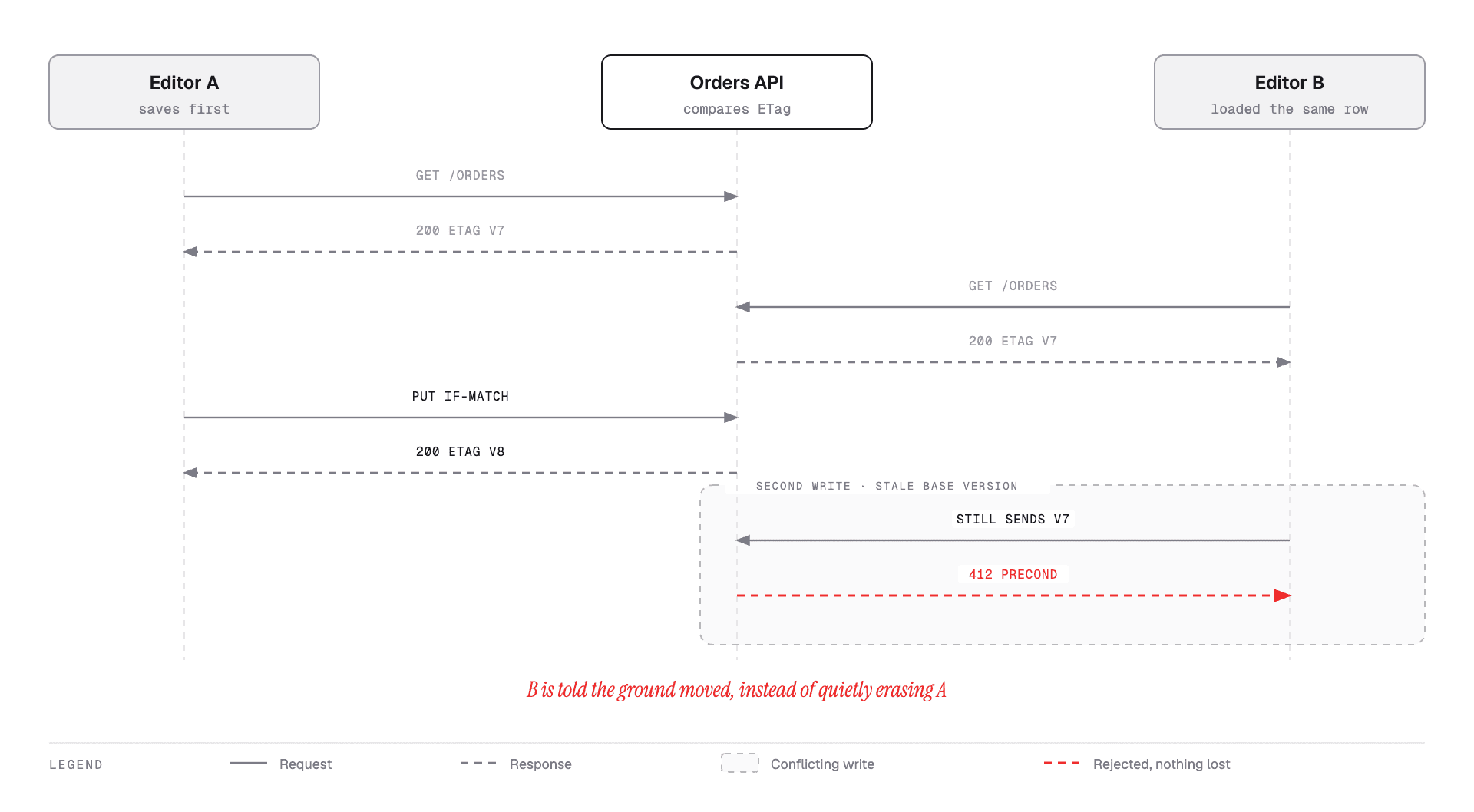
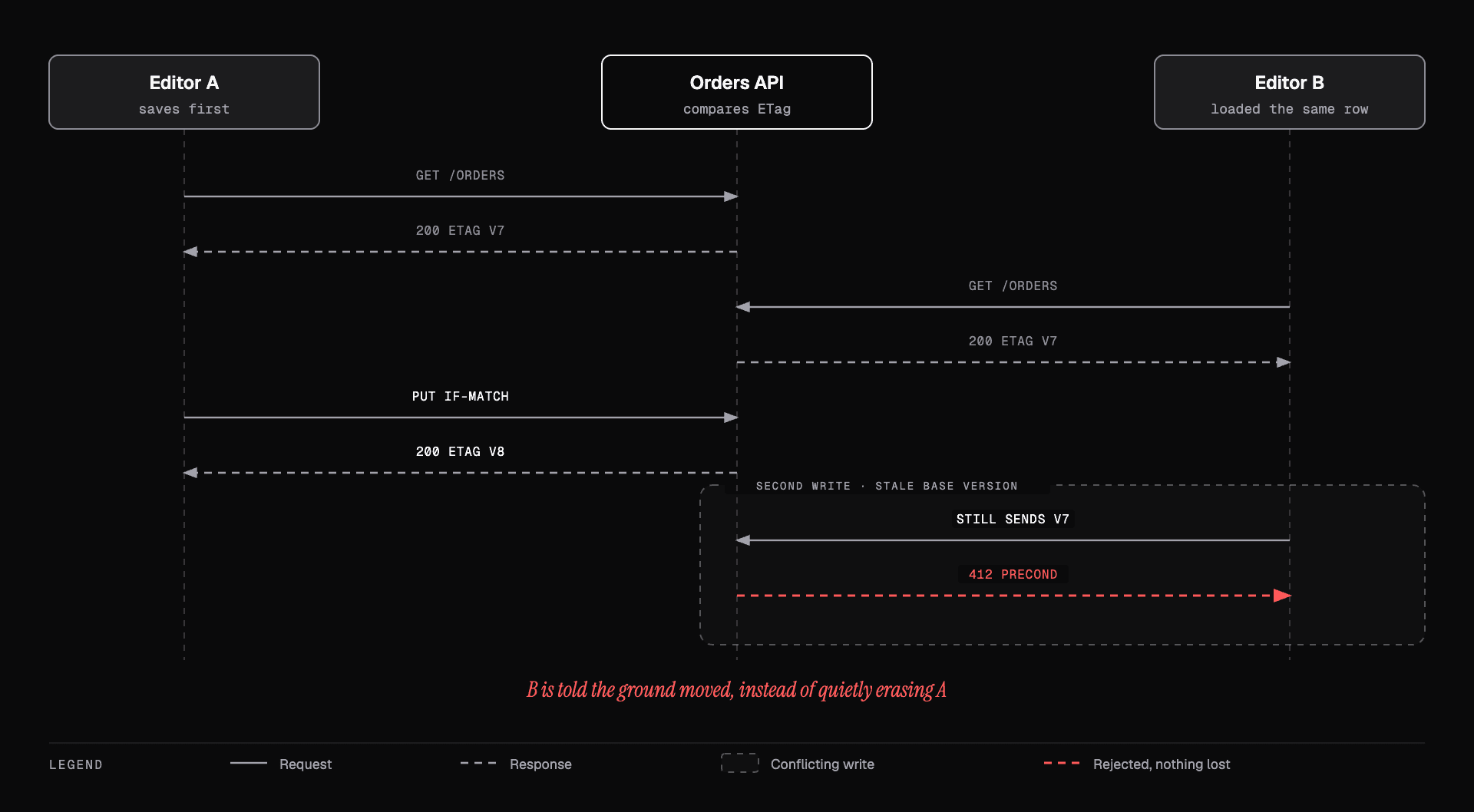
The check and the write have to be one statement. A SELECT to compare the version
followed by an UPDATE is the same read-then-write race that idempotency keys have to
avoid, just with a different prize:
const expected = req.headers.get("if-match");
if (!expected) return new Response(null, { status: 428 });

const version = Number(expected.match(/v(\d+)"$/)?.[1]);

const { count } = await db.order.updateMany({
  where: { id, version },
  data: { status: body.status, version: { increment: 1 } },
});

if (count === 0) {
  const current = await db.order.findUnique({ where: { id }, select: { version: true } });
  return Response.json(
    { type: "/errors/stale-version", title: "The order changed since you loaded it" },
    { status: current ? 412 : 404, headers: current ? { ETag: `"order-${id}-v${current.version}"` } : {} },
  );
}
updateMany is not a bulk call here — it is how you get a predicate beyond the primary key
plus a row count back. The count is the answer: one means you held the current version,
zero means someone moved it.
Example 3 — 412, 409, 428, and what the client does with each
412 Precondition Failed — the client sent a validator and it is stale. It knows which
version it had, so it can fetch the new one and show a diff.
409 Conflict — the request conflicts with current state for a reason that is not a
validator: cancelling a shipped order, reusing a taken slug. There is nothing to refetch
and compare; the client has to change the request.
428 Precondition Required — the client sent no validator at all on an endpoint where
overwriting blind is not allowed. This is what turns optimistic concurrency from a
convention into an enforced rule; without it a client that simply omits If-Match gets
last-write-wins back.
What the client must not do is retry automatically with the new ETag. That is a last-write-wins overwrite with extra steps. The correct handling is to refetch, show the two versions, and resubmit only what the person re-confirms:
const res = await save(draft, etag);

if (res.status === 412) {
  const fresh = await refetch();            // has the new ETag
  const conflicts = diff(base, draft, fresh);
  if (conflicts.length === 0) return save(merge(draft, fresh), fresh.etag);
  return showConflictUI(conflicts);         // a human decides
}
Fields that were not touched by either side merge cleanly. Fields both sides changed are a question, not a bug — and asking it is the entire point of having rejected the write.
When the key expires, everyone arrives at once
A hot entry expiring is not a cache miss. It is N concurrent cache misses, and they all reach the origin before the first one finishes writing the new value back.
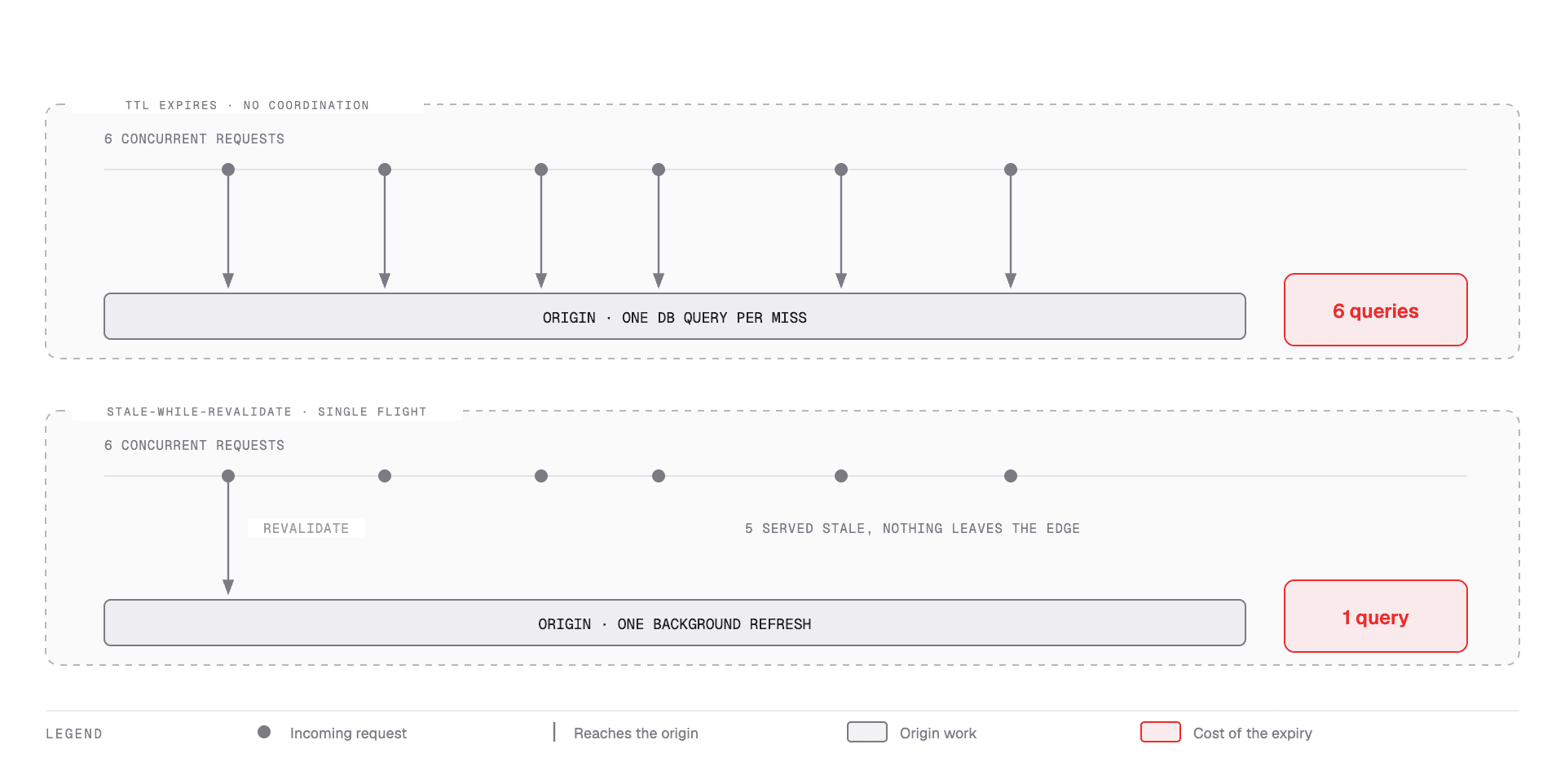
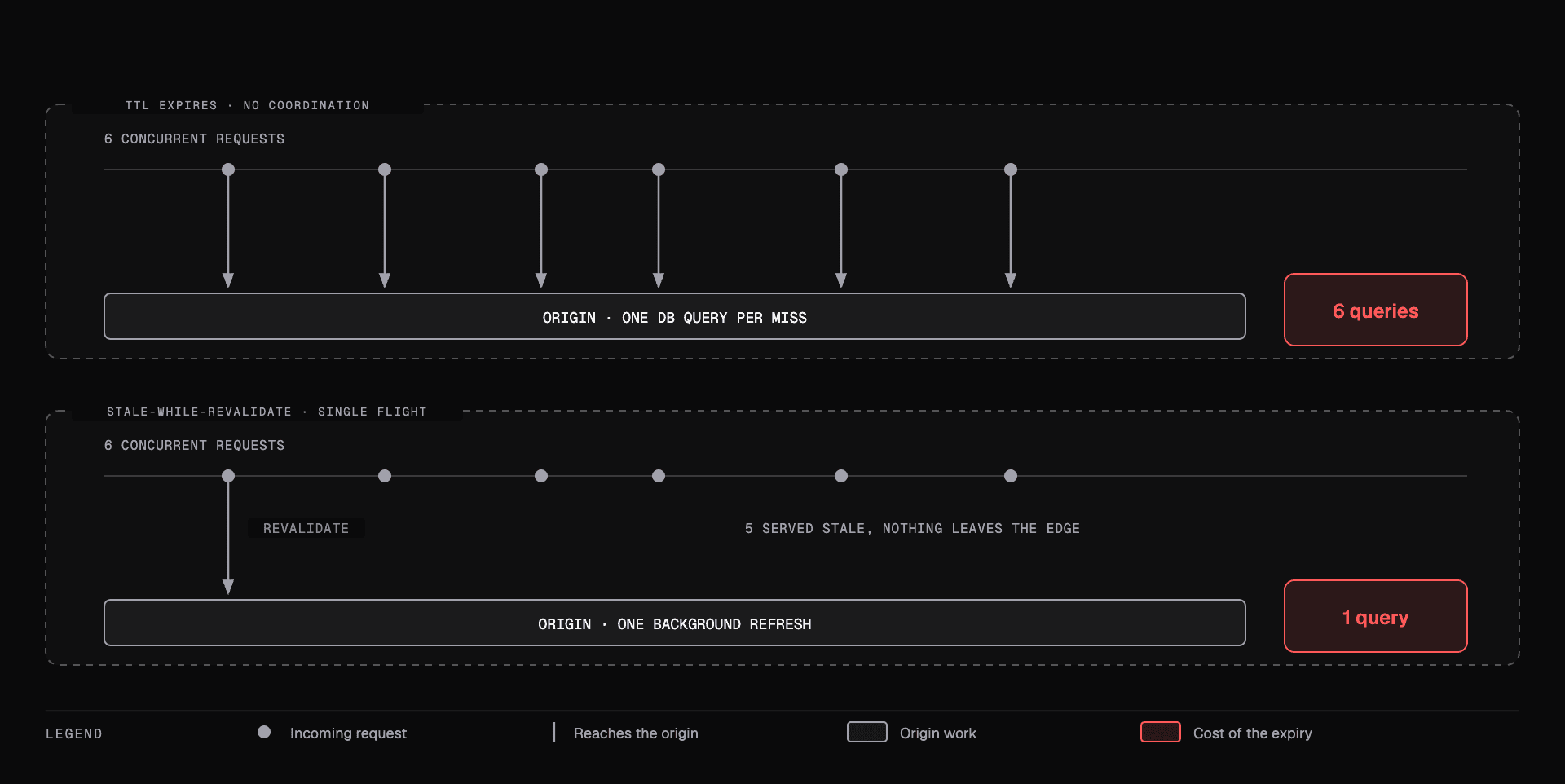
At the edge, two numbers instead of one:
Cache-Control: public, s-maxage=60, stale-while-revalidate=300Fresh for 60 seconds. For the next 300, a stale copy is served immediately while a single background request refreshes it. Nobody waits on the origin, and the origin sees one request per refresh rather than one per reader.
In-process, the same idea is a map of in-flight promises:
const inFlight = new Map<string, Promise<unknown>>();

function singleFlight<T>(key: string, load: () => Promise<T>): Promise<T> {
  const existing = inFlight.get(key) as Promise<T> | undefined;
  if (existing) return existing;

  const promise = load().finally(() => inFlight.delete(key));
  inFlight.set(key, promise);
  return promise;
}
Example 4 — the stampede you only get after a deploy
Single flight is per process. Ten replicas means ten concurrent origin queries, not one — enough for a read replica, not enough for a query that takes two seconds. Coordinating across replicas needs a shared lock:
const lock = await redis.set(`lock:${key}`, id, { NX: true, PX: 5000 });
if (!lock) return serveStale(key) ?? waitForRefresh(key);
The second failure mode is synchronised expiry. Keys written together expire together — a warm-up loop, a cache primed by a deploy, a nightly job — so the whole set falls due in the same second and the stampede returns at a thousand times the width. Fix it where the TTL is chosen, not where the miss is handled:
const ttl = base * (0.9 + Math.random() * 0.2); // ±10% jitterBoth defences answer different questions. Jitter stops a crowd from forming. Single flight handles the crowd that forms anyway, because some keys are hot enough that a thousand readers arrive inside the same millisecond no matter how the TTLs are spread.
Four ways an ETag quietly stops working
A proxy recompresses the body. Your handler emits a strong ETag over the identity
representation; something downstream gzips it. Strong tags promise byte equality, so the
correct tag for a representation that survives transformation is weak — W/"order-812-v7"
— which asserts semantic equivalence only. Range requests need a strong tag; everything
else is usually fine weak.
Serialization is not deterministic. Hashing JSON.stringify(row) is stable only if key
order, float formatting and timestamp rendering are stable. A map iteration order that
varies per process turns every request into a miss, and the symptom is a cache that looks
enabled and never hits.
Replicas disagree. Any per-instance input to the tag — a process-boot salt, a hostname, an in-memory counter — means two replicas answer the same URL with two different validators and revalidation never matches. Derive it from data, never from the machine.
The tag never changes. A version column incremented by application code is skipped by
every migration, backfill and psql session that writes directly. Clients then hold a
stale body indefinitely with no error anywhere. If the tag comes from a column, a trigger
or the database's own row version is what makes it true.
Long-running work
Do not hold a connection open for two minutes. Accept the work and hand back somewhere to look:
POST /exports
→ 202 Accepted
  Location: /exports/9f2c

GET /exports/9f2c
→ 200 OK
  {"status": "running", "progress": 0.42}

GET /exports/9f2c
→ 200 OK
  {"status": "succeeded", "result_url": "https://..."}
The status resource is a real resource with its own lifecycle. This also gives retries
somewhere safe to land: combined with an idempotency key, a retried POST /exports returns
the same Location instead of starting a second export.
Webhooks
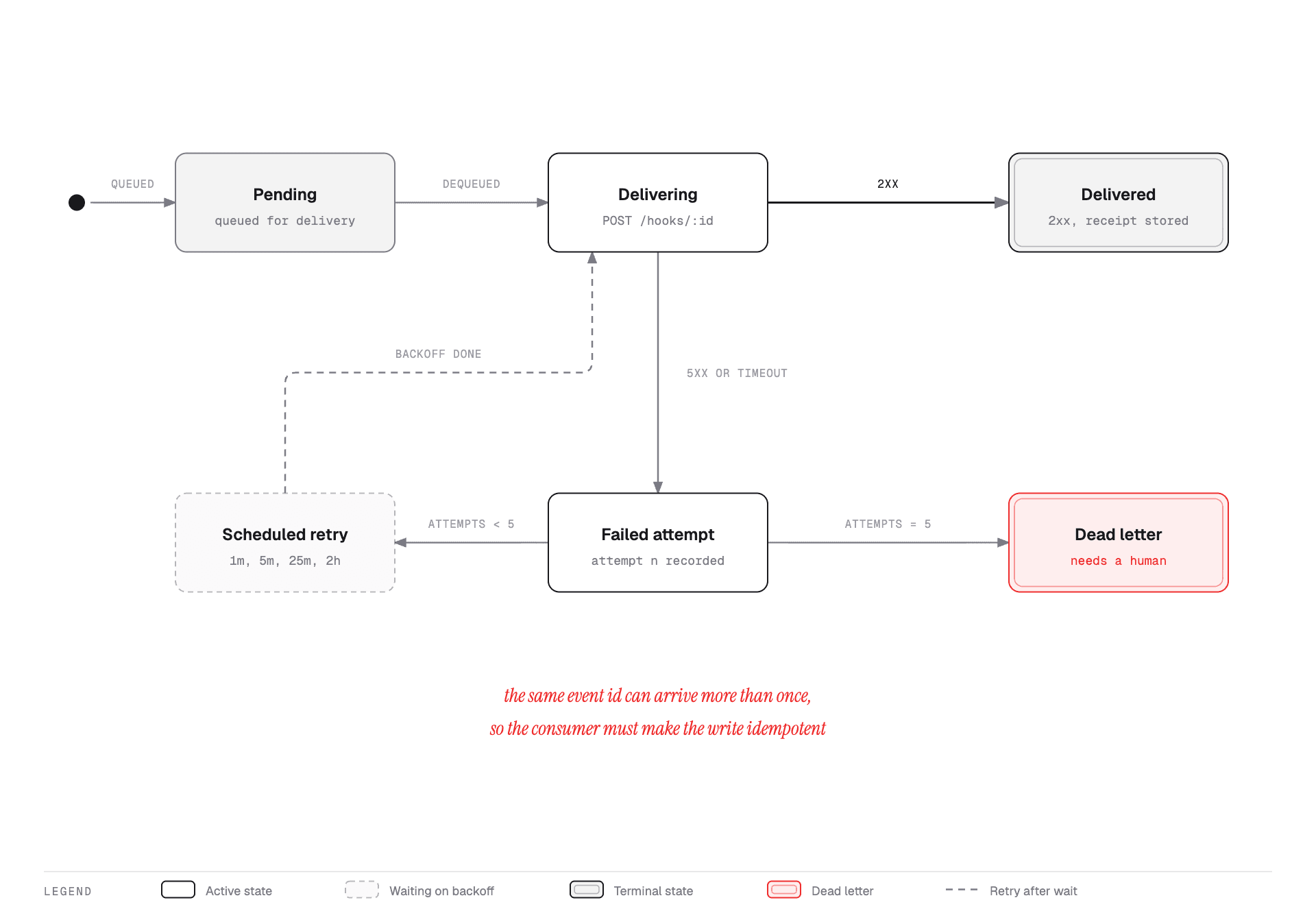
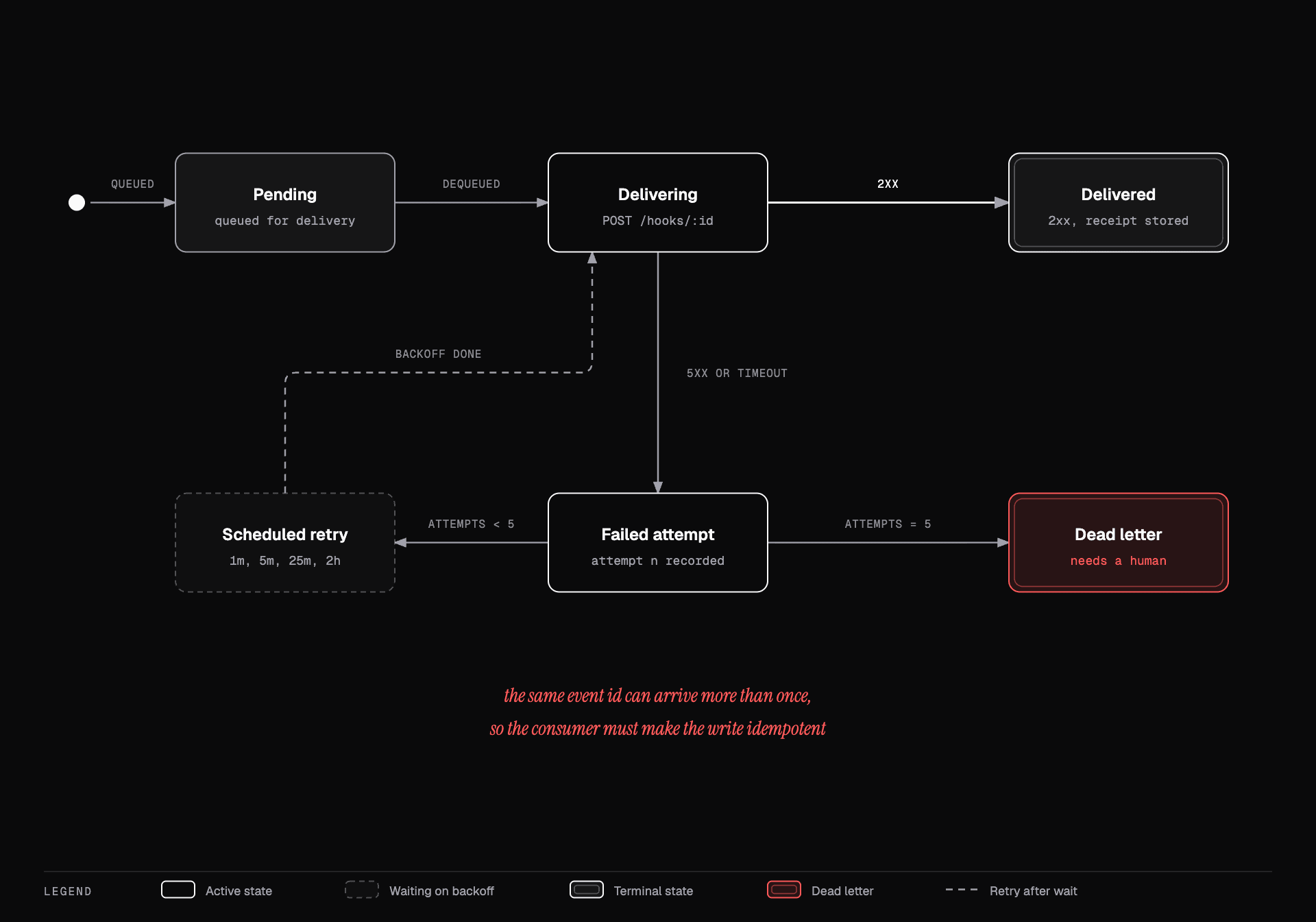
You are now a client of someone else's flaky endpoint. Four things to get right:
Sign the payload. HMAC-SHA256 over the raw body plus a timestamp, sent as a header. The timestamp prevents replay; the receiver rejects anything older than a few minutes. The receiver must verify against the raw bytes, because re-serialising the JSON changes them.
Retry with exponential backoff and a cap. Something like 1m, 5m, 25m, 2h, then a dead letter queue. Add jitter so a recovering consumer is not hit by every pending delivery simultaneously.
Deliver at least once, never exactly once. You cannot distinguish "the consumer did not
receive it" from "the consumer received it and the acknowledgement was lost." So you retry,
and duplicates happen. Include a stable event_id and tell consumers to deduplicate on it.
Order is not guaranteed. Retries reorder events by definition. Either include enough state in each event that order does not matter, or include a sequence number and let consumers discard stale ones.
How to say it: "Webhooks are at-least-once. The producer signs and retries with backoff; the consumer deduplicates on event id and tolerates out-of-order arrival. Exactly-once delivery over an unreliable network isn't available — exactly-once processing is, and it's the consumer's job."
Bulk endpoints and partial failure
The moment you accept an array, you have to answer: what if item 7 fails?
All-or-nothing — wrap it in a transaction, fail the whole request, return 400. Simple
to reason about, painful for a client submitting 500 items where one is bad.
Per-item results — return 207 Multi-Status (or 200 with a result array) where each
entry carries its own status:
{
  "results": [
    { "index": 0, "status": 201, "id": "ord_1" },
    { "index": 1, "status": 422, "code": "invalid_currency" }
  ]
}
Either is defensible. What is not defensible is returning 200 and quietly dropping the
failures. Pick one, document it, and make retrying the failed subset possible — which
means per-item idempotency keys, not one key for the batch.
REST, GraphQL, gRPC
A short, honest comparison rather than advocacy.
REST/HTTP+JSON. Universal tooling, cacheable by URL, debuggable with curl. Tends toward over-fetching (you get the whole resource) and under-fetching (a screen needs four requests).
GraphQL. The client asks for exactly the fields it needs, which genuinely helps
client-heavy products with many screen shapes. The costs are real: HTTP caching mostly
stops working because everything is a POST to one URL; the N+1 problem moves into your
resolvers and needs batching (DataLoader) to stay survivable; and query cost analysis
becomes a security requirement, because a nested query is a denial-of-service vector.
gRPC. Binary protobuf over HTTP/2, generated clients, streaming, and a schema that is enforced rather than documented. Excellent between your own services. Awkward from a browser without a proxy, and harder to debug by hand.
The framing that lands: REST for public and partner APIs, gRPC between internal services, GraphQL when one API serves many differently-shaped clients and you are prepared to own the caching and cost-analysis work it moves onto you.
Contract first
Write the OpenAPI (or protobuf) definition before the handler. Generate the client from it. Validate requests and responses against it in tests. Diff it in CI and fail the build on a breaking change.
This turns "don't break the contract" from a code-review convention into something the pipeline enforces, and it is a strong thing to describe in an interview because it is a process answer, not a trivia answer.
Recall checklist
Cover the right column and see if you can produce it.
- Which methods are safe, which are idempotent, and why it matters for retries
- Why
PATCHusually is not idempotent - The three steps of idempotency-key handling, and why the unique constraint does the work
- What happens when the same key arrives with a different body
- Why the key is scoped to an attempt rather than to a click or a session
- What a page reload does to a client-generated key, and how a server-issued identifier closes that gap
- Why
OFFSET 10000is slow, in terms of what the database physically does - Why a keyset cursor needs a unique sort key
- Three changes that are additive and three that are breaking
- Why you cannot pick a sunset date without per-client usage metrics
- Why
200with{"success": false}is a broken error contract - The revocation trade-off between JWTs and opaque tokens
- Token bucket versus fixed window, and the boundary burst problem
-
If-None-MatchversusIf-Match— caching versus lost-update prevention - Which directive binds the browser, which binds the CDN, and what
privateprotects - Why
no-cacheandno-storeare not synonyms - When a
304saves work and when it only saves bandwidth - Why the version check and the write have to be the same statement
- What a client should do with a
412, and why auto-retrying is last-write-wins - Why a hot key expiring is a load spike, and what jitter and single flight each fix
- Why webhook delivery is at-least-once and what that obliges the consumer to do
- Two defensible answers for bulk partial failure
- One real cost of GraphQL and one real cost of gRPC